
- 100,000+Assistance cases handled by the digital channel
- x2Adoption growth in one year
- ~85%Request success rate
A digital channel to free up the call center at peak times
The sector: Roadside assistance and automotive support
The challenge
Our approach
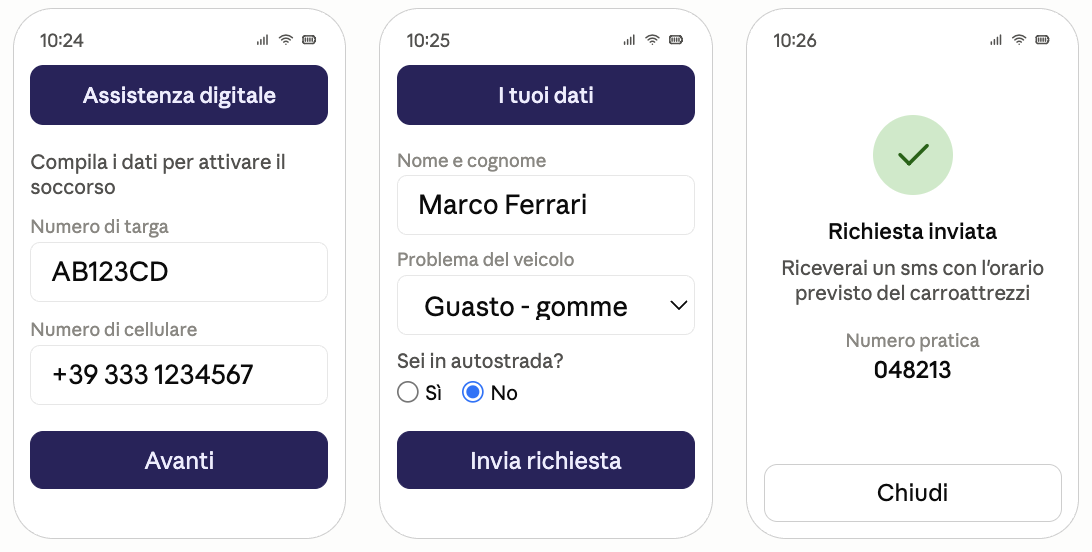
We designed an alternative digital channel, built to fit into the existing call flow without disrupting it: during the phone call, an automated message invites the user to continue via a link sent by SMS.
From there, in a few steps on their smartphone — license plate or chassis number, a few vehicle details, location — the system verifies insurance coverage in real time and, if everything checks out, lets the user request the tow truck directly. Only the cases that genuinely need an operator (highway, abroad, uncovered cases) are redirected to phone support.
Behind the scenes, the system integrates with the company's existing switchboard and its legacy management system: neither had originally been designed for a self-service channel, so much of the work was building a bridge between a new digital process and an already-consolidated enterprise infrastructure.
The choices we made — and why
Two paths were on the table: a cloud-native architecture, more scalable but slower to launch, or a solution built on the client's existing infrastructure. To be ready in time for the peak season, we chose the second path — faster to bring into production and with minimal impact on the client's IT teams.
The infrastructure was sized on the client's real traffic data from day one — not on a rough estimate — with the goal of sustaining the service's growth over time. And indeed, as we'll see, adoption of the digital channel more than doubled within a year without requiring any extraordinary infrastructure intervention.
Timeline
The results
Since launch, the digital channel has handled over 100,000 assistance cases out of roughly 680,000 eligible calls — about 1 case in 6 completed without ever going through an operator. But the most interesting figure is the trajectory: adoption of the digital channel has nearly doubled within a year, growing from about 13% to 23% of eligible calls, a sign that once users discovered the service, they kept choosing it.
The service, which started with 19 pilot contracts, has been progressively extended to cover 23 partner automotive brands. And the flow itself proved reliable: week after week, between 80% and 90% of users who started the digital procedure completed it successfully.
What came next
The impact
Steadily growing adoption, beyond the initial launch
Infrastructure that holds up even during seasonal peaks
A platform extendable to new channels and use cases
Related stories
 FINANCE & CONTROL
Automating the reconciliation of roadside assistance forms
OCR that reads complex handwritten forms, extracts the relevant fields, and classifies them for fast and accurate reconciliation.
 HUMAN RESOURCES
Reducing call-center handling time with AI
Operators retrieve immediate, source-backed answers via chat during a call, powered by Aevoluta's Sophia AI model.
 MARKETING & COMMUNICATION
Optimising media-relations processes workflow
A low-code application selects, aggregates and distributes agency press releases through an 'intelligent' engine.