

Marketing was one of the first fields to be “invaded” by wave after wave of automated tools, one for every piece of the process: first the email and newsletter platforms (Mailchimp, HubSpot, Klaviyo…), then the ones for scheduling social content (Hootsuite, Buffer…), the SEO and content-optimization tools (Semrush, Surfer SEO…), and so on.
With generative AI, content creation — copywriting in particular, with Jasper, Copy.ai, and above all ChatGPT — has entered teams' daily work faster than in almost any other business function: the latest edition of McKinsey's State of AI survey (2026) confirms it, showing marketing and sales among the functions where AI use most often generates a measurable revenue increase.1
- 37%Revenue increase from AI
37% of organizations report a revenue increase from AI use in marketing and sales over the past 12 months — the highest share across all business functions, just ahead of 36% for product/service development. Source: McKinsey, “The State of AI in 2026: On the road to ROI,” August 2026 (Exhibit 7)
The moving scope: today's projects aren't last year's
The context moves even faster than the tools themselves, and over the past year the spontaneous adoption of AI models among marketing teams has grown significantly: people started using generative tools on their own, often before the company had even defined a proper adoption strategy.2
This creates a real paradox: an innovation project that starts with a defined scope has to reckon, six months later, with a team that has already changed its habits in the meantime — not necessarily because the technology itself has changed, but because how people use it has, continually shifting the bar for what actually needs to be built.
- 22.4%Generative AI adoption in marketing
22.4% of marketing activities now use generative AI, up from 7% just a year earlier. Yet no marketing technology activity scores above 5 on a 1–7 organizational effectiveness scale: adoption is outrunning execution. Source: The CMO Survey — Spring 2026 Results
The result is twofold: sensitive data leaves the company's perimeter, and results stay inconsistent and out of context, missing the chance to build an effective strategy.3
- 33%Sensitive data in unapproved AI tools
33% of employees admit to having entered sensitive company information into unapproved AI tools — and over 57% already use personal AI accounts for work. Source: Gartner, “Top Cybersecurity Trends for 2026,” February 2026 (sample of 175 employees, May–November 2025)
It's a governance issue that many organizations are now facing head-on, and one that has to be addressed before scaling any AI initiative. Ignoring it means building on a foundation that will sooner or later produce unpredictable results — or expose the company to risks nobody had considered.
An AI project that actually works
In this context, building an AI solution that genuinely empowers a marketing team doesn't mean simply picking the right model — it means starting with a detailed study of the process that involves the people who are part of it from start to finish: understanding where the team loses time, how mature its autonomous use of AI tools already is, where the bottlenecks form, which activities are repetitive enough to be automated reliably, and where an integrated AI model actually makes sense and delivers real efficiency.
In practice, in our approach, this means inserting an intelligent layer — in this case the “Marketing Intelligence Layer” — between the team's processes and the tech stack the company already uses: CMS, DAM, CRM, marketing automation, and so on — without necessarily dismantling everything that's already there.
Together with the team, we analyze the as-is processes, identify the highest-impact initiatives, and evaluate case by case what should stay exactly as it is, what just needs to be connected better, and what, in some cases, is worth replacing — in a functional orchestration built and tested side by side with the people who will use it every day.
Adobe, Salesforce or the content management system stop being standalone tools and become part of a single flow, with the Marketing Intelligence Layer coordinating the work in between: it can, for example, catalogue the digital assets the company already owns on its own, build landing pages and newsletters from templates already in use — writing the copy too — or suggest the right content for each campaign instead of leaving someone to hunt for it by hand among thousands of files. These are just some of the things it can do: the real scope is defined together with the team, depending on the process.
In this example, the journey of a piece of content through the Marketing Intelligence Layer might look like this:
- gathering the brief and context: tone of voice, already-approved assets, similar past campaigns;
- generating the draft — copy, landing page or newsletter — using the templates and assets already approved;
- human review before publishing: someone who knows the brand checks, edits and approves;
- publishing, with the review feedback stored for the next campaign.
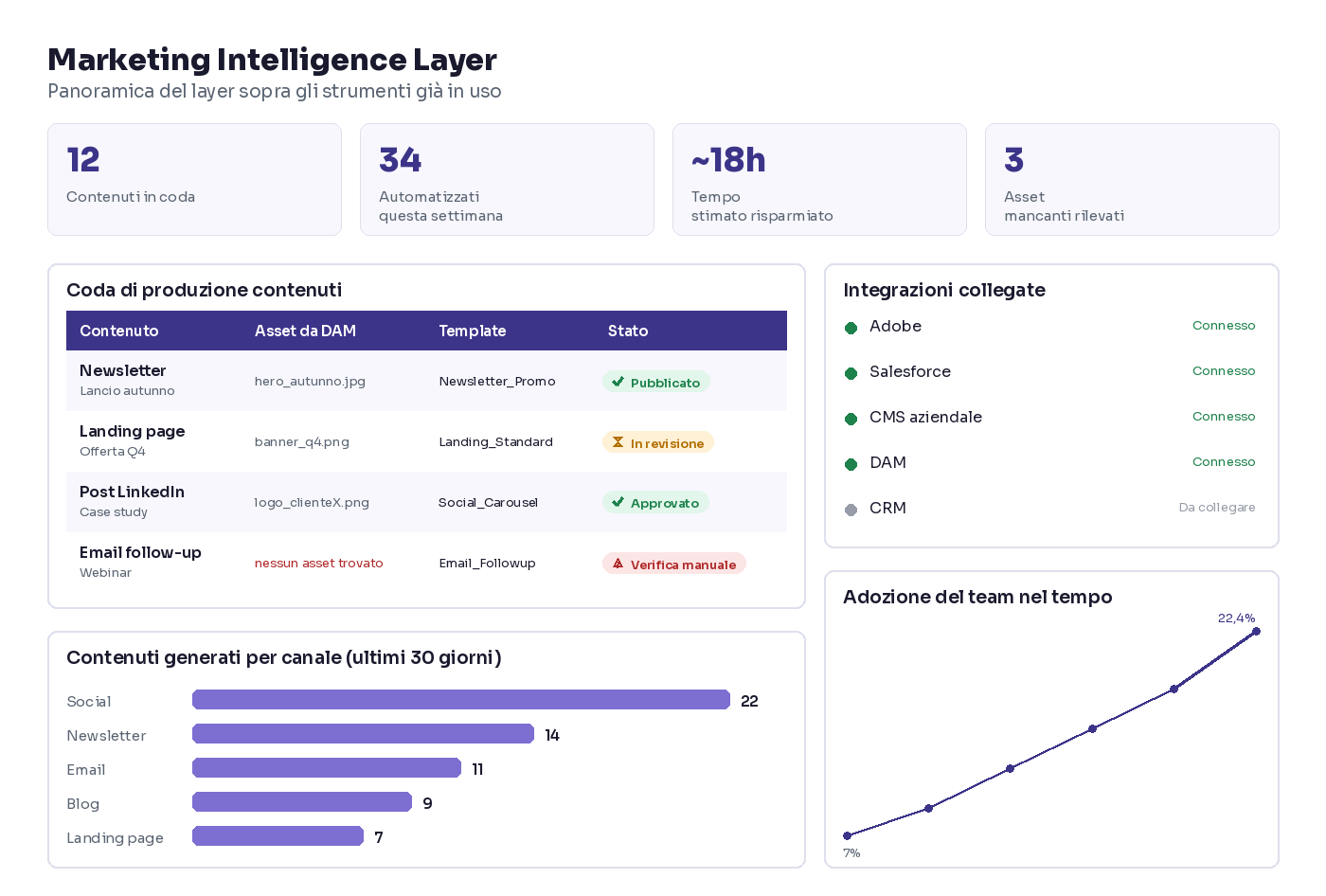
An integrated AI tool like this knows the context: it knows which campaigns have already been done, the brand's tone of voice, which assets are approved — while a generic tool starts from zero every time. The gap in quality, consistency and real speed is much bigger than it seems at first glance.
One last important point concerns adoption: marketing teams, often buried in repetitive work during peak periods, can initially prove resistant to a new tool because they feel the learning cost before they see the benefit. That's why a well-structured project always includes an AI adoption path for the marketing team that supports people instead of leaving them alone in front of a new tool — and it's easier to accept when that new tool is designed around their real needs and doesn't require throwing away everything they already know.
This is what separates a successful project from an automation that gets used for a few weeks and then falls into oblivion: not the technology chosen, but the method used to design and introduce it.
In short
AI in marketing isn't a question of tools, it's a question of approach. Using ChatGPT or any other model in an unstructured way isn't wrong in itself (as long as data security is respected), but the next step is figuring out how to move from spontaneous, individual use to a solution that works for the whole team — safely, consistently and measurably.
Request an assessmentWant to know how many of your marketing team's recurring activities can be automated? Request an assessment of your process: we start from your real volumes and estimate what you can automate completely and what will always need human oversight.
Sources
- 1.The State of AI in 2026: On the road to ROI — McKinsey, agosto 2026 (Exhibit 7)
- 2.The CMO Survey — Spring 2026 Results — Duke University Fuqua School of Business, 2026
- 3.Top Cybersecurity Trends for 2026 — Gartner, febbraio 2026 — campione di 175 dipendenti, maggio-novembre 2025