

The critical point is well known: recording an invoice demands absolute precision even when the source data is incomplete, and the useful information is scattered across documents, orders, regulations and people's experience. The result is too much time spent looking for information instead of deciding.
Two tracks of control: firm rules and artificial intelligence
Automation moves along two distinct tracks that, when needed, intertwine.
Deterministic controls. Checks based on firm, repeatable rules: dates, periods, amount reconciliation, quantities, codings. Where they apply, they provide a certainty — compliance with the rule — and move the invoice toward a correct posting.
AI-based controls. Many assessments, however, cannot be reduced to a rule: they require accounting and tax knowledge, or they adapt to information that changes every time. Think of attributing the correct account, recognising the nature of an invoice with no order, or handling accruals and deferrals. This is where AI comes in: with a probabilistic approach it combines general knowledge and knowledge specific to the individual case, supplier and order, in order to obtain a correct accounting posting and its reconciliation. Highly accurate, but never infallible. That error rate is not a flaw to hide — it is a variable to design and keep measured.
The user at the centre: human in the loop
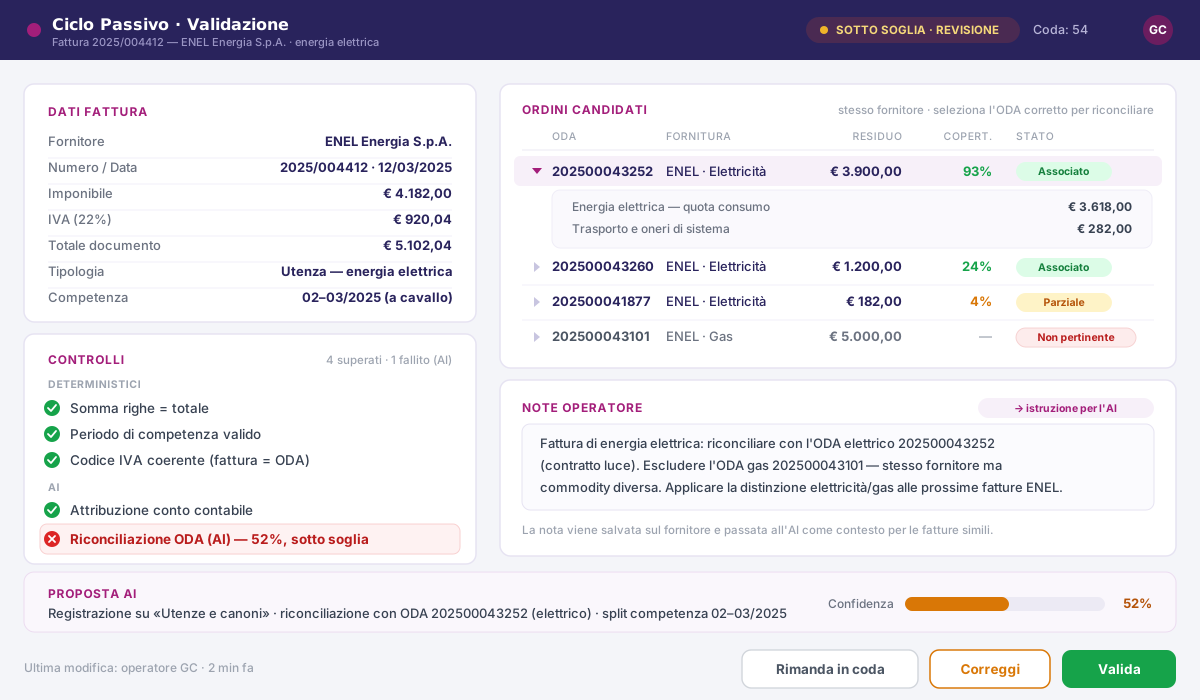
To manage that error you do not rely blindly on the model. You pair it with deterministic controls downstream that, when they are not passed, call on the process owner for help. A dashboard gathers, for each case, all the information the operator needs to handle the reconciliation: the applied controls and the AI's interpretation. The operator then applies their judgement and either confirms or corrects it.
The user's work is not an end in itself: the specific handling of that case is saved and associated with the supplier and with the type of order and invoice, so that it becomes information the AI can use to handle the next invoice with the same characteristics.
The threshold applies to the validator too
There is a point that is often forgotten: if AI is wrong in a certain percentage of cases, so is the user. Expecting to replace an imperfect person with an infallible tool is ambitious, but at times utopian. If we accept human error as physiological, we must accept the machine's too — with the advantage, though, that this error can be measured and caught before it reaches production. In practice the goal cannot be to eliminate errors, but to learn to recognise them, measure them, decide what level is acceptable, and ensure that, beyond that threshold, nothing is posted without a human eye.
From data to posting in SAP
Downstream of the decision-making system, a bot operates on the ERP — SAP, for example — to reconcile and post the invoice. The full path is linear:
- acquisition of invoices and orders
- data extraction and lookup against related open orders
- application of the deterministic and AI controls
- validation (or not) by the process owner
- at this point the path forks:
- reconciliation and posting
- manual handling of the complex case
In summary
A truly smart process does not bet on the infallibility of technology: it makes the work faster and higher-value, and it lets you govern the error. Firm rules where applicable, AI where judgement is needed, an acceptable-error threshold, a process owner to handle the complex cases, and the memory of those cases to automate them in the future.
Want to know how many of your supplier invoices can be automated? Request an assessment of your process: we start from your real volumes and make a realistic estimate of the share that can be fully automated and the share that needs human supervision.